


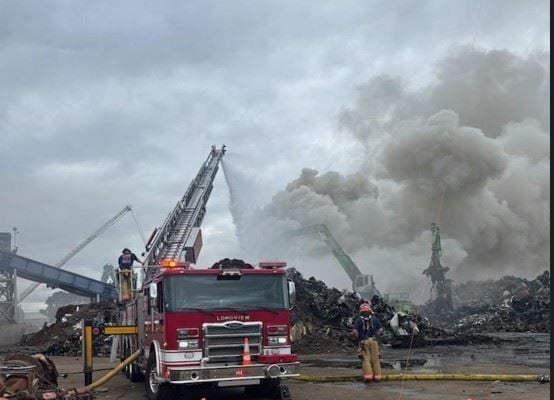
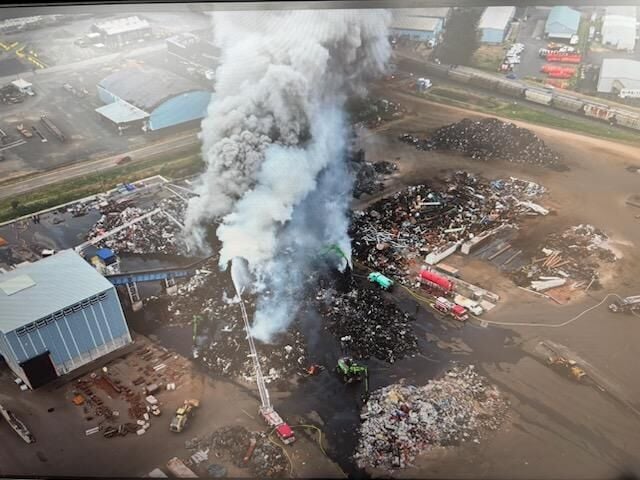
Longview Fire Department and Cowlitz 2 Fire & Rescue crews responded to a large fire at PNW Metals shortly after 12:30 p.m. on July 25. A large column of smoke was already visible from Longview Fire Station 81 when the call was dispatched. Because the fire was producing significant smoke, responding units approached from the upwind direction to reduce exposure and safely evaluate conditions.
The initial priorities were ensuring the safety of employees and emergency responders, protecting the facility’s buildings and infrastructure, notifying and protecting the surrounding community, confining the fire to the property and bringing the incident to a safe conclusion. Public notifications were distributed through social media and other public media channels advising residents in affected areas to remain indoors, close windows and doors and avoid exposure to the toxic smoke. The facility had only a limited number of employees on site, and no metal processing was taking place that day.
People are also reading…
Strong winds pushed the fire through multiple piles of scrap metal. Firefighters established several operational divisions around the site to surround the fire and prevent it from spreading beyond the facility. Crews used three aerial ladder master streams, engine-mounted master streams, portable monitors and handlines. Fire apparatus had to be repositioned several times as fire, wind and smoke conditions changed. Once conditions improved, PNW Metals employees used heavy equipment equipped with grapples to separate the burning material so firefighters could reach and extinguish deeply embedded areas of fire.
The incident continued for approximately 17 hours. Longview Fire Department maintained command until approximately 3 a.m., when command was transferred to Cowlitz 2 Fire & Rescue for the final stages of the operation. Units cleared the scene shortly before 5:30 a.m. on July 26 and returned to service by 7 a.m. after completing equipment decontamination, restocking and rehabilitation.
At the height of the incident, 26 firefighters and command personnel from Longview Fire Department, Cowlitz 2 Fire & Rescue and Cowlitz County Fire District 1 were assigned to the site. More than 41 fire department personnel and 14 firefighting apparatus, utility vehicles and command vehicles were used throughout the response. Longview Fire Department recalled 14 off-duty employees to maintain emergency coverage throughout the city and provide relief for crews working six- to eight-hour operational periods. Clark-Cowlitz Fire Rescue and Cowlitz County Fire District 5 provided backfill coverage while regional resources were committed to the incident.
Water supply presented a significant challenge because of limitations in the facility’s private water-main infrastructure. City of Longview Water and Utilities personnel helped establish additional water supplies from Port of Longview property. Firefighting operations used an estimated average of 3,500 gallons of water per minute, with peak demand exceeding 5,000 gallons per minute. More than 3.5 million gallons of water were used during the incident. To maintain uninterrupted operations, Cowlitz 2 Fire & Rescue mechanics refueled apparatus at the scene twice.
The response included Longview Fire Department, Cowlitz 2 Fire & Rescue and Cowlitz County Fire District 1. Other agencies involved or consulted included Clark-Cowlitz Fire Rescue, Cowlitz County Fire District 5, the Washington Department of Ecology, the local diking district, the U.S. Coast Guard, Cowlitz County Department of Emergency Management, Cowlitz 911, City of Longview Water and Utilities, Cowlitz County Sheriff’s Office, Port of Longview and representatives from PNW Metals.
A follow-up inspection was conducted on July 27 by the Longview Fire Marshal, Cowlitz 2 Fire & Rescue personnel and PNW Metals representatives. The final report is pending.
PNW Metals receives, sorts and shreds scrap metal before exporting bulk material by ship and rail for recycling into new products. The successful containment of this complex incident demonstrated the value of regional partnerships, coordinated planning and the ability of public agencies and private-sector partners to work together during a prolonged incident.


