


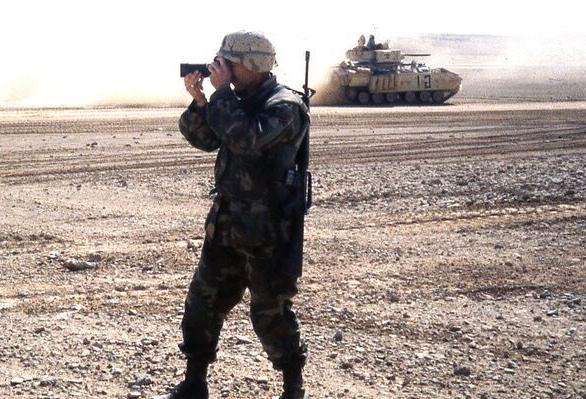
Desert Storm, 103rd PAO, MTARNG, attached to the 3rd Armored Cavalry Regiment photographing tanks moving forward prior to the invasion of Iraq.
For Charles Milo McLeod, life was divided into two interests: archeology and photojournalism.
“Though the two kind of go hand in hand in terms of creating historical records, the military gave me the opportunity to do something entirely different from my regular job for the U.S. Forest Service,” the longtime Missoula resident said.
McLeod’s 35 years as a member of the Montana National Guard provided the diversity and challenges he craved in life. Decades of traveling with a camera in tow as part of the Army Public Affairs department, recording life in the military in Australia, Korea, Germany, Saudi Arabia, New Zealand and Europe, as well as several stints in Florida, California and Hawaii, allowed McLeod to see the world. While those assignments were part of his regular directives, what stands out most was his one year as a mortar and rifleman with the 173rd Airborne Brigade in Vietnam.
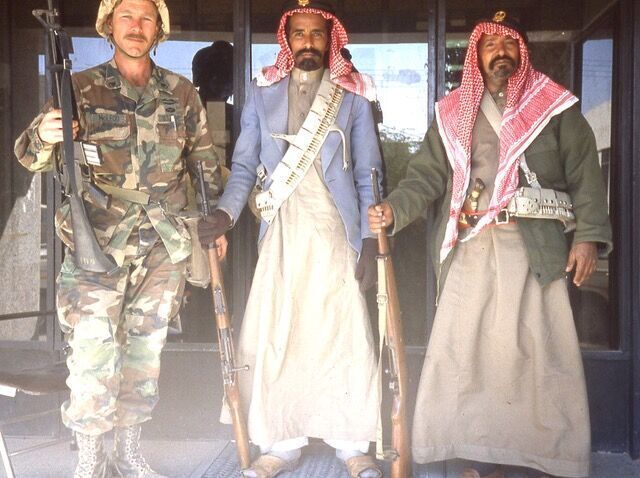
Charles M. McLeod standing with Bedouin Bank Guards in Hafar Al Batin February, 1991.
In 1968 McLeod had completed three years of college at the University of New Mexico, with an intended major in anthropology, when he decided he needed a change. He enlisted into the infantry and attended airborne school. His first assignment landed him with the 509th Airborne infantry in Germany. A year later he was sent to Vietnam.
“Everything is new when you first go there,” he said. “It was kind of scary and you knew you were there just to replace someone. And you were the new person until someone else showed up after you, and that could be a week, two weeks or a month.”
McLeod’s platoon was assigned to provide security to a Vietnamese village. When infantry squads would go on their daily patrols, his platoon provided fire support, illuminations and whatever else they needed. After about six months, he became a rifleman in the line company and found himself out in the fields: “‘Humping the bush’ is what we called it, 6 to 10 kilometers every single day, carrying a rucksack that weighed 60 to 80 pounds.”
McLeod considers himself lucky. A week after returning from Vietnam, two members of his squad were killed and four were wounded when a Vietnamese kid selling soda pulled a grenade out of his cooler instead and it detonated.
“Those were my guys,” McLeod said. “I had been with them just days before.”
He returned to school, finished his degree and took a job with the National Park Service in New Mexico. Shortly after, he learned Montana was starting an archeology department, but the position required the applicant to have a graduate degree. So he re-enrolled in school. Needing a little extra money while taking classes, he joined the National Guard. Thus began his “other” career, eventually landing as a photojournalist in the Guard’s Public Affairs unit.
“My first assignment as part of my annual Guard training was working on the archeological project at Little Bighorn Battlefield. From there, I was sent all over the world to take photographs and work with the civilian media,” McLeod said.
He covered Desert Shield and Desert Storm in six-month increments. His Guard unit in Montana was mobilized to the Middle East as part of the 18th Airborne Calvary Regiment.
During his “off-Guard” work weeks, McLeod’s civilian job was as an archeologist for the 2.3-million-acre Lolo National Forest in west central Montana.

Viet Nam March 1970, An Lo valley.
“And, no, we don’t do dinosaurs,” he said laughing. “The position had everything to do with old bones, arrowheads, historic tin cans, bottles — that sort of thing. Whenever I meet someone and say I was the archeologist they expected me to have a fedora and a bullwhip. But it’s really like any other job. You go to meetings, deal with budgets, personnel and somedays, if you’re good, they let you play in the sandbox.”
McLeod likes to think of himself as a cultural anthropologist. Uncovering history as an archeologist, recording history for the military.
“I certainly don’t consider myself a professional photographer, but I did try to document everything I could during my assignments,” he said. “During Desert Storm I captured a lot of photos of the armored tanks, troops fixing tracks and us rolling 240 miles into Iraq.”
In fact, many of his photos appeared regularly in the military publications even though the photo credit line was attributed to the U.S. Army.
“Still, I’d be going through a magazine and see something I took and thought that was pretty cool.”
During the more than three decades he served, McLeod picked up quite a few awards: Combat Infantry Badge, two Bronze Stars from different campaigns in Vietnam, a Meritorious Service Medal and Army Achievement Medals, to name a few.
“You spend 35 years someplace and you’re bound to pick up a few trinkets,” McLeod said humbly.
He retired from the Guard when he turned 58.
“Do I miss it?” he asked. “I miss the excitement of going to new and different places. I was older than most soldiers when I was in. When I went to Australia, for example, a lot of the other guys in my squad hadn’t graduated from high school or were just 18. They wanted to drink and find women. I was touring sheep ranches, horseback riding, you name it. I loved it. Now, I travel with my wife.”
McLeod long ago retired as an archeologist. But the 78-year-old still manages to pull out the camera every now and then to record what he sees.
To learn more about the "Stories of Honor" series, please visit www.states.aarp.org/montana/storiesofhonor. AARP is the sponsor of the Stories of Honor series, which features profiles of veterans across Montana.


