


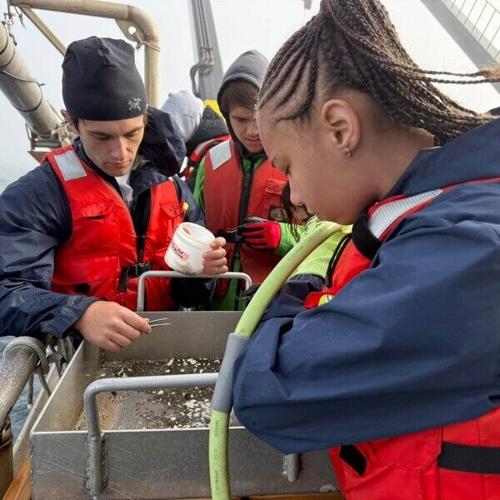
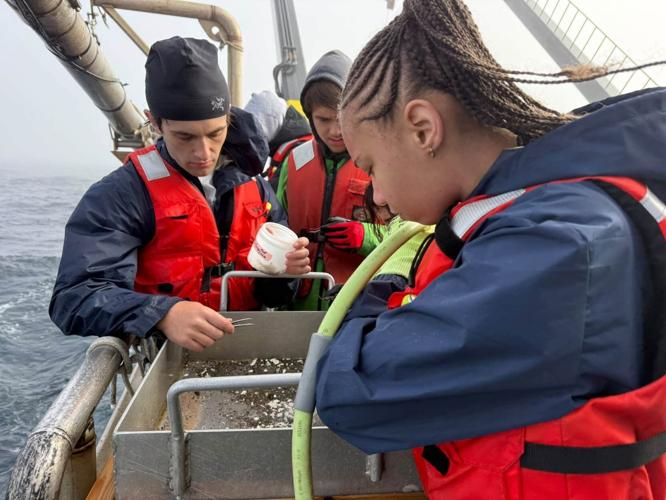
Seven miles off the Oregon Coast, 11 teenagers swayed on the deck of the R/V Pacific Storm, learning to keep their balance amid six-foot swells as researchers and crew expertly maneuvered the ship’s A-frame winch to haul samples of sediment from the ocean floor.
When the large shovel resembling an arcade claw game grabbed a big enough sample, students carefully sifted through the sand to document the creatures hidden within, from ghost shrimp to tiny sand dollars to potent Pacific stinkworms. Over their six-hour voyage, the team examined 11 samples taken within the PacWave wave energy test site, where future wave-energy devices will be anchored off the Oregon Coast.
The Newport High School International Baccalaureate biology students were the guests of Oregon State University’s STEM at Sea program, an Oregon Sea Grant initiative to bring high school, community college and undergraduate students on active research trips. The program celebrated 10 years in September.
People are also reading…
“Kids aspire to what they know,” said Tracy Crews, associate director of education for Oregon Sea Grant. “If they don’t realize all the pathways and different marine-related careers available, they’re not thinking about that as an option.”
Ship time for the student cruises is funded by the Oregon Legislature via the Oceangoing Research Vessel Program.
The program is also a win for early-career researchers and graduate students, who often need to collect preliminary data in order to secure research grants but have limited means to do so, and who benefit from the chance to practice science communication and near-peer mentoring of younger students.
In exposing students to a wide variety of marine professions, STEM at Sea creates a pipeline for the next generation of oceanographers, marine biologists, mechanical engineers and more to go on to study at OSU and pursue their own research goals.
Since STEM at Sea launched in 2016, more than 400 students from across Oregon have participated in about 50 research cruises. While the Newport High class returned to port by mid-afternoon, STEM at Sea journeys can last up to six days, with small groups of students berthing in the ship’s cabins belowdecks. Each year, Crews reserves 20 days on the Pacific Storm for trips in late spring and early fall, then hopes for fair weather.
The program started out with only multi-day trips and required students to apply individually, but Crews and her team quickly realized that this limited potential candidates to those who felt comfortable going out to sea with a bunch of strangers.
They expanded to offer classroom groups the opportunity to come with trusted teachers and focused on reaching rural, Indigenous and Spanish-speaking students in particular. Chemawa Indian School and Newport High’s English-language development program send classes every year, Crews said.
The shorter day trips help students get a feel for the research vessel and decide whether they want to apply for one of the longer trips.
It’s like “throwing fuel on the fire” for students who might be curious about a STEM career, said Newport High teacher Alissa Rickborn. She spent a lot of time on OSU research vessels completing her Ph.D. studying ocean acidification before she pivoted to teaching.
“I see a deeper level of engagement when they see that being a scientist isn’t just sitting in the classroom learning facts, but actually has real-world applications,” Rickborn said. “It reinvigorates them and gets them excited about learning this stuff.”
Genevieve Coblentz-Strong, now a development engineer in the Innovation Lab at Hatfield Marine Science Center, attended Oregon Sea Grant camps in middle school, traveling from Portland to participate in field trips and lab work. While taking community college classes as a high schooler, she went on a four-day STEM at Sea cruise on OSU’s previous research vessel, the Oceanus, and it changed her life.
Prior to the cruise, she planned to pursue marine biology, but witnessing the technology in action on the Oceanus sent her down a whole new path.
“I had a moment of, ‘Oh my god, the technology drives all of the science,’” Coblentz-Strong recalled. “That led me to start thinking about technology and engineering and how that could play into the ocean world that I love so much.”
She went on to double-major in oceanography and mechanical engineering at OSU, and now works in the iLab building devices like the environmental DNA sampler she developed as an undergraduate.
OSU researcher Dawn Barlow was on that same Oceanus cruise with Coblentz-Strong when she was a Ph.D. candidate in Fisheries, Wildlife, and Conservation Sciences. She’s now an assistant professor in the College of Earth, Ocean, and Atmospheric Sciences and the Marine Mammal Institute, studying what drives the geographic distribution of protected species of whales and seabirds.
“It’s hard to find opportunities to collect pilot data and try out new technology. STEM at Sea has been this incredible partnership for researchers to collect pilot data, try new things and ask these really tricky research questions where you need some starting point,” Barlow said. “It’s been a real gift to be able to do that through STEM at Sea, and for the students, they’re getting to see research at the very early stage.”
That includes seeing researchers find things they’ve never seen before, Crews said.
“We are making real discoveries out there, and students get to have that realization that we really don’t know much,” she said. “We talk about how little the ocean has been explored and how things are changing due to climate change.”
The thrill of discovery adds to the joy of the program overall, Crews said, especially in an era of increasing precarity for researchers as grant funding is slashed across the country.
“To be around the students and young faculty, to see their enthusiasm — they’re so engaged and they really love their work,” she said. “Being able to share that love and that passion and that enthusiasm, and inspire the next generation, I think that’s really why most of us are involved in this.”


