

Materials
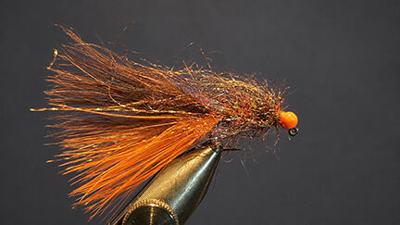
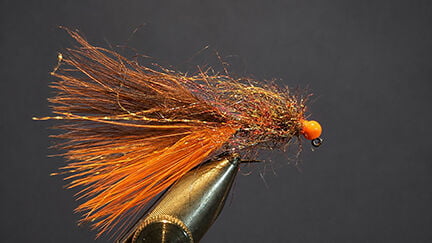
Hook: 60-degree jig hook, size 10-14 (shown as size 10)
Bead: Bright orange slotted tungsten bead sized to your hook (shown 1/8 inch)
Thread: Fluorescent orange, 6/0
Body: Canadian brown simi-seal blend
Tail: Fluorescent orange, chocolate brown marabou with root beer Krystal Flash
Tools: Dubbing spinner, dubbing brush, whip-finisher
Tying instructions
Start by putting a thread base on your hook. Tie in a tail that is the length of the shank or a bit longer. Begin tying in the tail at the base of the bead. This locks the bead in place and gives a good underbody for the fly. Tie in the orange marabou first and then the brown on top of it. This fly will fish upside down, and it works best with the orange on top.
People are also reading…
To get the accurate length for the tail, measure the marabou to length and hold the marabou near where you want to tie it in right behind the bead. Then strip off the fluff at your tie-in point. This gives you a more solid tie-in point. Hold the orange marabou on the top of the hook shank as you make slightly open wraps of thread, working back to the base of the tail. Then repeat the process for your brown marabou. Tie in two strands of flash on each side of the tail.
Create a dubbing loop with your thread. Pull dubbing in sparse clumps and try to get the fibers parallel to each other by using your fingers. A simple tip is to cut a corner of the dubbing package and pull your dubbing out of the package through this corner. This helps align the fibers better. Put the sparse clumps in the dubbing loop. Try to make sure you have an even distribution of sparse dubbing up and down the loop. Then spin up your dubbing noodle.
Use your dubbing brush to brush out the noodle a bit. Wrap to the base of the bead and then secure with thread. Whip finish and use a touch of superglue or head cement to secure the finished wraps. There will be an orange collar visible behind the bead. Use the dubbing brush to fluff out the dubbing on the body of the fly.
How to fish it
Late into the fall, trout are more active as they look to bulk up for the winter. This is an attractor fly that has some of the hallmarks of other successful leech patterns. The original Halloween pattern was more of a woolly bugger fly. This is a modification of that classic. The fluorescent orange colors are emblematic of the spirit of Halloween, and they can also get trout to eat.
You can strip this fly on floating or sinking line, depending on depth, or fish it under an indicator. Do not be afraid to move this fly. Twitching the indicator is a good way to instigate a strike. Using wave action on a breezy day is also very helpful.