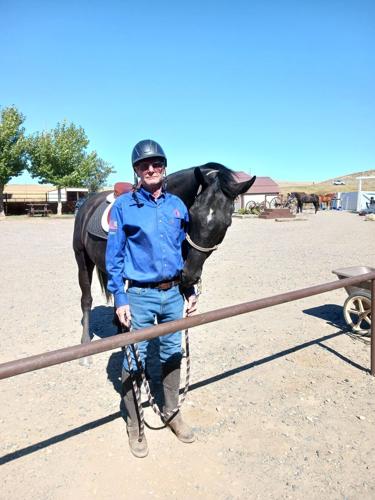



Navy veteran Denis Bunts
“Never did anything spectacular.”
So says Denis Bunts, Navy man, who served from 1980 to 1984. His title: Engineman Fireman on the nuclear-powered USS California during the Gulf War.
This humility is typical of the way Bunts talks about those years aboard the ship — years in which he and his fellow sailors went around the world. They sailed through every ocean, chased submarines, fired missiles and even painted the ship by hanging over the side while it was moving. They cruised the North Atlantic in January and February, through 45-foot swells in minus-20-degree temps with icicles clinging to the masts.
One of his coolest memories, however, is attaching a 5-foot pole to the bottom of a supply helicopter while the “boat” was pitching up against the waves. (Bunts said if you’re in the Navy you can call it a boat. If you’re not, it’s a ship.)
Called a vertical replenishment, or VERTREP, it was one method of supplying seaborne vessels by helicopter. Supply pallets are loaded onto a net and then a crewman stands on the ship’s deck with the pole trying to connect it to the bottom of the helicopter.

“At one point I was on my hands and knees because the waves were throwing us up and rocking us this way and that, and the helo was battling the winds all at the same time. That helo was 5 feet above me at one point. Quite an experience.”
Other times, Bunts said, the ship would receive supplies in what was referred to as a connected replenishment, or CONREP. In those instances, a supply ship would come within 50 feet of Bunts’ ship, connect the two using a cable and then send the cargo over a tensioned wire system. Cargo would include everything from food and tools to ammo and fuel.
Bunts said attention to detail was paramount during either exercise, but especially during a CONREP transfer.
“You just didn’t want to get caught up in any of the wires strung between the two ships,” he said. “When the ships depart in two separate directions, if you have a steel wire wrapped around you, you’re a goner. So yes, doing things the right way first is the one lesson we all learned right away.”
As a non-nuke engine specialist on the ship, Bunts was in charge of caring for everything on the ship that backed up the nuclear system, ensuring the ship’s power and propulsion systems were functioning properly. That included operating, servicing and repairing the two onboard emergency generators, the small boats, captain’s and officers’, the boilers, pumps and HVAC systems.
“We had to make sure that the ship’s small boats could ‘light off’ the ship within three seconds during an emergency evac. If the reactors scammed, meaning a rapid shutdown, the ship is dead in the water.”

Denis Bunts, 2025
Bunts explained this can happen when the reactor’s output is too high or when a safety condition is breached. If people need to be evacuated, they have seconds to do so. Hence, the vigilant maintenance of the ship’s small boats.
Bunts loved being on the water during his four years in the Navy.
“There’s nothing like it,” he said.
Today, however, the closest the Billings resident ever gets to water is on his regular float trips down the Yellowstone River.
“I went in reverse, I guess,” he said laughing. “I had a blast while I was on the ship, but I don’t care to be on the water like that anymore. It’s just one of those things you’d never have the opportunity to do any other time in your life and I was able to do it. And the discipline and attention to detail I learned from that experience is what has carried me through today.”
Quite a spectacular adventure for a humble sailor.