


Even when she’s flying commercial, Amanda Sell rates a pilot’s landing.
After 32 years flying in the back of a helicopter as an Army flight medic, she had her share of critical take-offs and landings. Ferrying injured troops in and out of Kuwait and Iraq often required smooth approaches and departures, with the four crew members simultaneously watching for enemy fire, staying alert for obstacles since they had to fly low and slow, and treating injuries, some grievous.
“So when I’m on a commercial flight now and the plane jolts upon landing, I’m thinking, ‘What? Did the ground just suddenly sneak up on you? Did you not use your radar?’” she said, laughing.

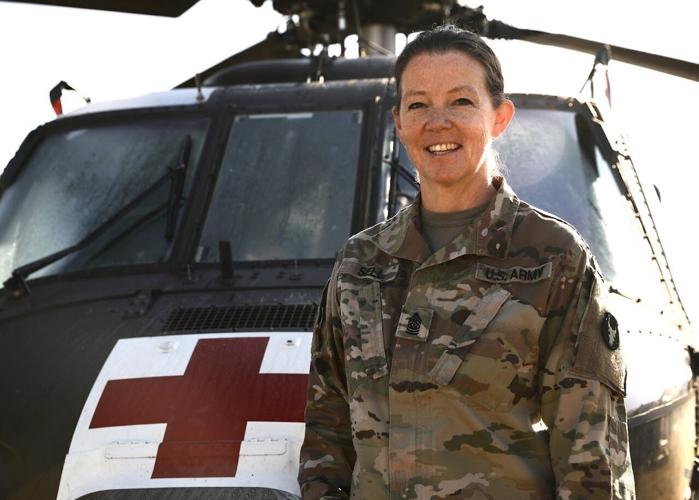
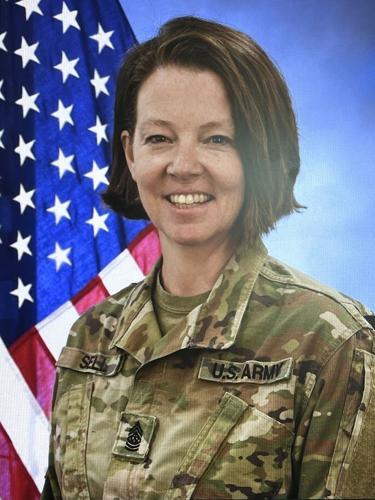
Amanda Sell, Command Sergeant Major of the 189th General Aviation Support Battalion
When she initially considered the military, her dream was to become a Top Gun pilot. Her dad, who spent 36 years in active duty for the Montana National Guard, encouraged her to join the Guard first. Her grandfather and two brothers had also served in the National Guard. In fact, two of her three sons are currently serving in the National Guard.
“The military is our business,” the Missoula resident said. “It’s all we knew growing up. It was instilled in us that we should support our country.”
For two weeks every summer and drilling once a month — during the four years enrolled at the University of Montana — Sell worked in an operational capacity for the 189th General Aviation Support Battalion, headquartered in Helena. The unit conducts combat support, search and rescue, fire suppression and disaster response. The more she learned, the less she yearned to be a pilot and the more she wanted to become a flight medic.
Following her graduation with a bachelor’s in sociology and criminology, Sell underwent 10 weeks of basic combat training and 16 weeks of advanced medical training, earning her EMT certification. She also learned advanced medical skills like hemorrhage control, shock management and IV insertion; field skills including evacuation techniques, patient assessment and treating casualties under fire; and field sanitation, which involves maintaining hygiene in deployment settings. With only one medic on a Black Hawk helicopter — in addition to the pilot, co-pilot and crew chief — Sell also had to go through flight training.
“You learn how to be a crew member. As a medic, you are literally in the ‘back of the bus.’ Not only did I have to learn how to work with the crew, I had to simultaneously be able to intubate a patient, apply pressure to wounds and perform other advanced medical skills — all the while watching out for obstacles outside the helicopter,” Sell said. “You’re doing all this wearing a helmet, listening to the crew chief alert us to what he is seeing and what the pilot is seeing.”
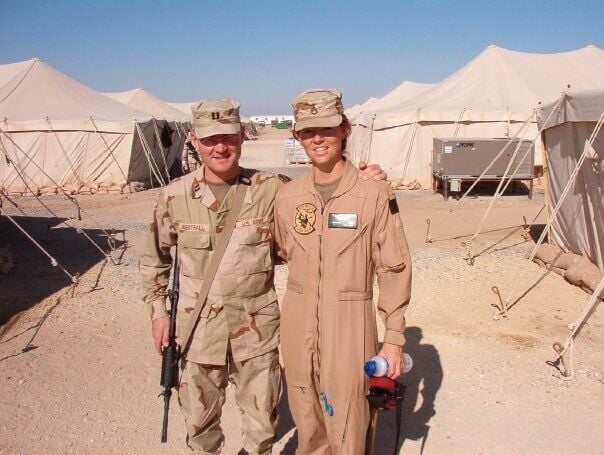
Amanda and her older brother Jeff Westfall, circa 2004
Sell was deployed to Kuwait with the 1022 Medical Company (AA) for one year, during which she flew 47 missions.
“Conflict for a medevac team looks a little differently for us than from a troops standpoint,” she said. “Because we are in an aircraft with large rotor blades and an even larger red cross on the side of the helicopter, we are an easy target. It seems counterintuitive to people who don’t understand, but we fly low and slow, typically not more than 50 feet off the ground, so radar can’t lock on us. That’s why we are trained to help the pilots stay clear of obstacles like wires and terrain, for example.”
Whenever the call for help came, Sell said, the adrenaline would start to flow and the crew would be ready to move immediately. During one rescue, a soldier had a femoral artery laceration. As the pilot in command was getting the necessary information on where they were to go, as well as the patient’s status, “he looked at me and said, ‘this could be a bloody mess.’ He started running to the helicopter.
“We were told the patient was going to be moved from the point of injury to the troop medical clinic, but I knew from my medical training that any extra movement could be lethal,” Sell said. “I instructed the pilot to land instead at the point of injury, which wasn’t the safest place for us to be. But my pilot trusted me, and when we reached the soldier, we were able to apply pressure on the artery, slide him into the aircraft and treat him in the air before landing at the hospital. By getting to him early enough at the point of injury, we were able to save his life.”
For their action, the crew was awarded the Sikorsky Winged-S Rescue Award, a prestigious award given to medevac crews and helicopter pilots who perform life-saving missions.

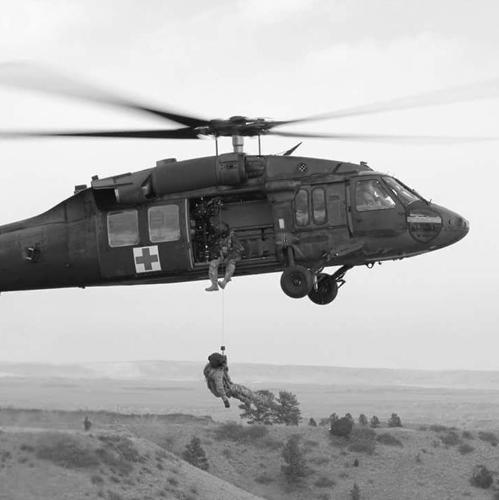
Salmon River hoist recovery mission
Stateside after her deployment, Sell recalled the recovery of a hiker who had fallen 200 feet off a cliff to his death along the Salmon River in Idaho. The area was heavily wooded, and the search-and-rescue crew had been unable to find the hiker, so they called the National Guard to help.
“We were on about our last lap, praying we could find the body,” she said. “And for just one second, by the grace of God, the sunlight hit the dew on the hiker’s arm at the bottom of the cliff, and it was enough of a shine to reflect back to the pilot.”
But the hard part was yet to begin. Because of the steep terrain, Sell had to be lowered from the underbelly of the copter with a MedEvac Skad, a flexible, rugged rescue stretcher used to move injured people from challenging environments, such as confined spaces that require vertical lifting.
“It was an amazing mission, but one of the scariest,” she said. “The downdraft from the aircraft causes spinning and turbulence for those of us hanging from the bottom of the helicopter. It’s one of the most dangerous things we can do as a medic. The family was grateful for us to have found him, even though it wasn’t the outcome they wanted.”

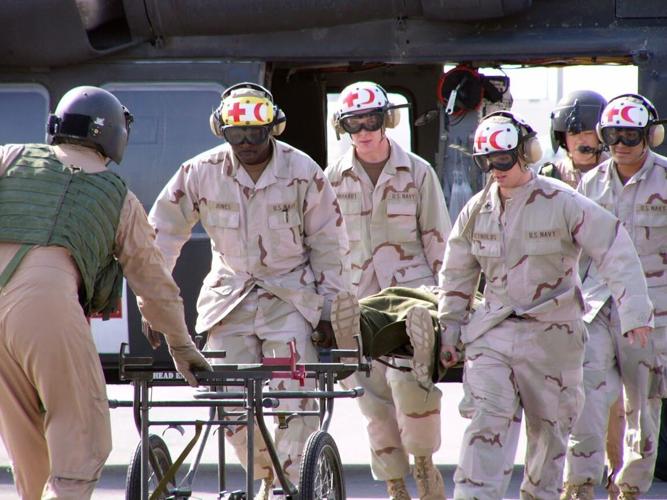
Amanda and her team offloading a patient at Camp Arifjan
Through her more than three decades of service, Sell was promoted through all nine enlisted ranks, even becoming the first female First Sergeant (1SG) in the 163rd Infantry BN. She retired from the 1-189th GSAB and came full circle having started and ending her career in aviation.
“I felt like I had fulfilled my duty. It was time,” Sell said. “But I loved being a medic so much, I decided to return to school and become a nurse.”
Sell graduated from Carroll College with her nursing degree and now works at the Community Medical Center as the director of risk and compliance.
“And the best part of it is, I don’t have to hang from the bottom of a helicopter,” she said.