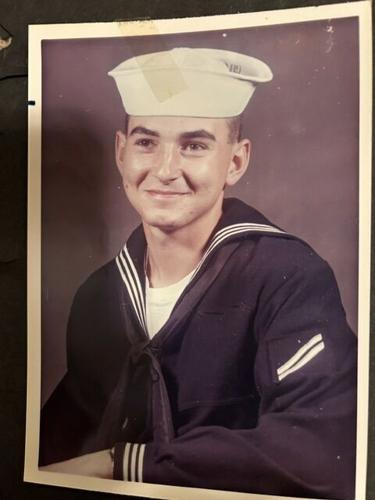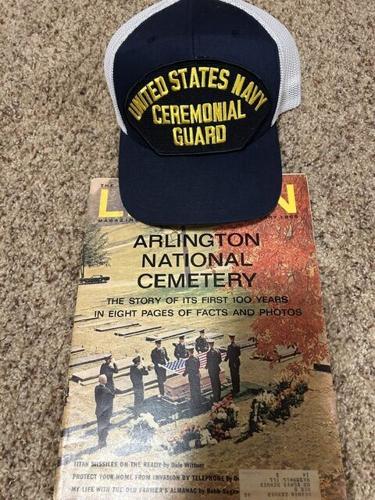



The size 10 ½ shoes displayed at the Naval Annex at Anacostia, Virginia, walked behind the caisson at President John F. Kennedy’s funeral and at President Herbert Hoover’s funeral. That doesn’t include the steps taken by the wearer at hundreds of Navy military funerals at Arlington National Cemetery.
For Navy Ceremonial Guard Charles Renner, it was an absolute honor. Passed down to him from fellow honor guardsman SA Edward W. Nemeth, who was immortalized in photos marching behind the caisson carrying JFK’s personal flag, Renner wore the shoes nearly a year later when, as one of eight, he carried Hoover’s casket up the Senate steps in October 1964. Throughout his year and a half of service as a Ceremonial Guard, he buried 400 enlisted Navy veterans, including officers and admirals at Arlington.
“The uniform worn by the ceremonial guards is precise, exactly the same from guard to guard,” Renner said. “The only thing that varies is the shoe size. Ed (Nemeth) and I just happened to have the same size, and when his year as an honor guard ended, he gave them to me. I think I probably paid him $20 or $30 for them. What an honor.”
Located at the Joint Base in Anacostia-Bolling, Washington, D.C., the U.S. Navy Ceremonial Guard’s primary mission is to represent the service in presidential, Joint Armed Forces, Navy and public ceremonies in and around the nation’s capital. Its members participate in some of the nation’s most prestigious ceremonies, including presidential inaugurations and arrival ceremonies for foreign leaders. It also serves as the funeral escort and conducts all services for Navy veterans at Arlington.
Renner’s hand was the only one raised following basic training at the Naval Station Great Lakes in 1963. JFK had been assassinated that week and the company commander was looking for a volunteer to join the Navy’s Ceremonial Guard immediately.
“There were 450 of us when the question was asked,” Renner said. “I was the only one of them to become a body bearer.”
He was immediately sent to Anacostia, where he trained with 120 other guardsmen. Service as a Ceremonial Guard lasts for one year. The next three months were filled with intense training, including learning to march in precision as a team of six (the number of men carrying a casket), how to carry a casket up steps in all weather and seasons, and how to maintain the ultra-strict standard of dress. Renner said a spot on the shoe or a loose uniform thread could result in a failed inspection.
Each guard ironed their own trousers, pressed sharply from seam to seam. Shoes were spit-shined with layers and layers of hardened wax, which takes hours and hours to master. Renner said it’s called spit shine because it involved actually spitting on a cotton cloth wound around the index and middle fingers, before dipping the cloth into black shoe polish. Repeatedly.
“You do that over and over from back to front of the shoe, the sides, the toe, until that polish seeped into every pore of the shoe,” he said. “It sounds gross, I know, but that’s how it was done and, out of more than 100 men, I never saw anyone use anything other than their spit. We were constantly polishing. If it wasn’t the shoes, it was the brass belt buckle or the gold on our uniforms. Twelve guys were always around the table, polishing. Every time you wore that uniform, you’d iron and polish it.”
Renner said his platoon would leave each morning on a gray Navy bus, along with the chaplain and the riflemen who fire the ceremonial shots during Navy funerals. On most days, there was a half hour between funerals, seven to eight a day, year-round. Once the families would arrive and walk to the grave site, Renner and his five guards would remain with the hearse.
“We had petty officers that would issue our commands of when to open the hearse door, take the casket out, walk it to the grave, place it at the grave site,” Renner said.

As part of the grave site service, Renner’s platoon would hold the flag over the casket and fold it precisely, and since he was the platoon leader, he would present the flag to the next of kin.
Kneeling, Renner repeated the mandatory words quietly while holding eye contact so the message would serve as a private moment: “On behalf of the President of the United States, the United States Navy and a grateful Nation, please accept this flag as a symbol of our appreciation for your loved one’s honorable and faithful service.”
“During our 3 ½ months of training, we became a master at folding the flag. You just don’t know how to describe the feeling, but we knew we didn’t want to ever make a mistake,” he said. “We were professionals and we had to do our absolute best. Every man standing next to you had the same experience of wanting to never make a mistake. We never did.”
Just when Renner’s time as a Ceremonial Guard was to end, he was asked to stay another six months to train for the funeral of former President Hoover, who had been suffering from chronic health issues. Since the Army oversees all presidential funerals, two soldiers are selected from each branch to serve. Renner was one of the two Navy men chosen.
“We knew how much the casket weighed, how much President Hoover weighed, and we went to a gymnasium and practiced carrying caskets up the steps,” Renner said. “Because of all the Senate steps, it was all about precision. How to keep the casket level at all times, which meant the guys in front were bent over more than the ones in the back. And there were no verbal commands, every movement done with head nods.”
Following the funeral, Renner was then invited to be an usher at President Lyndon B. Johnson’s inauguration in January 1965, where he was assigned to the dignitaries’ section. There, he escorted both U.S. Senators Robert F. Kennedy and Ted Kennedy to their seats. A photo from the event appeared on the cover of Life magazine where Renner is visible standing in front of his section.
Soon after, his friend Nemeth, who was graduating from Ceremonial Guard duty as an orderly for Chief of Naval Operations David L. McDonald, nominated Renner to replace him and assume his responsibilities. Renner then moved from Anacostia to the Marine barracks next to the Pentagon. During the remaining year and a half of his service, Renner worked for Admiral McDonald, setting up meetings at the Pentagon, passing security papers that were coming in daily from the Vietnam War, and other administrative logistics. He walked to the Pentagon every morning to start work at 6 a.m.
As a Ceremonial Guard, individuals do not hold military rank and pay grades. Renner retired from the service as a seaman, returning to his native Marshall, Illinois. He attended Indiana State for a year before moving to Florida, where he spent 18 years as head concierge for a resort hotel.
“The bellmen worked for me, and I treated them like they were members of the Ceremonial Guard,” Renner said with a laugh. “I cleaned them up, made them get haircuts and kept their uniforms sharp. They were the best-looking bellmen ever.”
And to this day, Renner still irons his own clothes and folds them like he did in the service.
“I even do ironing for my wife if she wants,” he said.
Renner, now 81, moved to Missoula 31 years ago with his wife, Susan. Ironically enough, his father-in-law owned a funeral home in Marshall. In fact, Susan and her sister lived in Moore Funeral Home growing up.
“He used to love hearing about my stories in the Ceremonial Guard,” Renner said. “Regular funerals are totally different. People don’t really dress up anymore to attend one.”
Renner confessed that he watches every military funeral that is televised these days.
“I love to critique them and see how the guards are doing. The media usually don’t get footage of the entire procession from the hearse to the grave site, so I can only just study the facial expressions of the Ceremonial Guards,” he said.
And that’s big.
“You know, I’ve thought about that a lot, too. The eye contact. It’s a very solemn moment when you pick up a casket. You can look across the casket at a man, the same age as you, could be your best friend, and it’s solemn. Someone might think, ‘Oh, you do an eyeroll or try to make someone smile.’ That never happens,” Renner said. “You are just waiting for that next move to turn exactly at the same time. Your movements are precise. Everything is coordinated.”
Renner admits he hasn’t visited the shoes he donated to the museum in Washington, D.C.
But he doesn’t have to. He walked in them.